honey and walnuts strewn between
thin layers of phyllo,
I remembered that stay in Istanbul,
the stars shimmering as we walked
back to our hotel, our hearts
and Chora Church, now an Ottoman Empire Mosque,
its walls glazed with intricate tiles,
Today’s prompt from Maureen Thorson, the host of NaPoWriMo asks us to write a poem that anthropomorphizes a kind of food. Maureen says: "It could be a favorite food of yours, or maybe one you feel conflicted about. I feel conflicted about Black Forest Cake, for example. It always looks so pretty in a bakery window, and I want to like the combination of cherries and chocolate . . . but I don’t. But how does the cake feel about it?"
Ah, but what about foods you don't like -- or can't easily have just now?1
Got up too early,
my legs are cold,
even so, new beginnings.
Friday marked the beginning of Passover. Part of the service is to remember the Holocaust. Sunday, today, is Easter. How can we write of tragedy and hope, without being angry? For, even as we celebrate one or both of these holy days, isn't Russia continuing its war against Ukraine, displacing some 4.7 million so far and killing and/or injuring thousands more?
I have no words today.
Join in April's Poetry Challenge with Robert Brewer of Writer's Digest. Brewer says: "For today's prompt, write a mad poem. There are things that make us mad as well as things that drive us mad. Whatever your interpretation of the word, I hope you have fun with this prompt."
Catch up on all the poetry prompts from Robert Brewer at Writer's Digest! Today's Poem-A-Day Challenge asks us to write a patience poem. Brewer says: "Your poem could be about someone or something with great patience, or it could come from the other direction (ie, impatience). One fun thing about this prompt is that it begs us to consider the various ways of measuring time: From the patience required to sit at a red light to the patience of a tree growing rings for centuries."
Today's prompt from Robert Brewer, of Writer's Digest, for National Poetry Month is to write a breaking poem. Brewer says that "the poem could be about breaking down walls, break dancing, breaking up, or breaking stuff. However you'd like to break it down and then write your poem."
Breaking/Not Broken
There is no broken glasshttps://www.writersdigest.com/write-better-poetry/2022-april-pad-challenge-day-9
Today's prompt from Robert Brewer for Day 8 of the Poem a Day Challenge is to write a 'what they never tell you' poem.
Robert Brewer says: "I'm not sure who "they" are, but "they" talk a lot, and there are things people tell you, and there are things you just have to learn on your own, because "they" (them again) never tell you ahead of time. Like, for instance, "they" never told me that I'd still feel like a teenager in my 40s, but here we are. Think about what "they" never tell (or told) you, and write that poem."
What They Never Tell YouToday's prompt by Robert Brewer for Day 5 of the Poem a Day Challenge is a 'Two for Tuesday' poem. That is, two prompts to write either one or combine, as you wish. Prompt 1: Make sense. Prompt 2: Don't make sense. Robert Brewer always includes his own response to inspire us. Today, his poem (see link above) is heartfelt.
Make Sense?
Why do we strive for order each day,Today marks the very first day of April. Last night, temperatures lurked near freezing, but on the way to the pond, we saw budding hyacinths, daffodils, and the first leaves of tulips pushing their way out of the ground.
Today also marks the beginning of the National Poetry Month with a challenge: To write a poem a day through the month of April. As we cautiously move past Covid restrictions, I'm not quite sure I'm ready. Perhaps this month will bring more haiku forms than longer verses, but that exercise each day of opening up to the possibility of a poem is intriguing. Writing poetry can be an act of reflection, of becoming more aware of what is around you and what is within. I shall begin. Will you join me?
Dreaming into Spring
Was winter this year and lastNow the book is off to beta readers. I'm hoping in another month to have it ready to publish. Hooray!
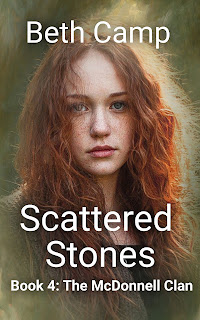
If you would like to be a member of my Advance Review Team, you can receive a free copy of Scattered Stones in exchange for your honest review.
Just e-mail me to let me know you'd like to join my team!
bluebethley@yahoo.com
As we stood at the rim of the volcano caldera, we could see an active pool far below, marked by steam vents and, once in a while, a tiny flare of fire.
"Come back at night," the park guide said. "You'll see amazing views." I thought of the two and a half hour drive back to Kona that was ahead of us. We did have a peanut butter sandwich in the car, and we were tempted. For a moment.
We passed signs that reminded us when we reentered the "No Fault Zone." Of course, Allen said it wasn't my fault, but I confess to feeling a little better when we were further away from that simmering volcano. We also saw many closed shops in several small towns as we drove north once again. Covid remains rather like the lava, seemingly permanent, changing all in its path. Most people wear masks, inside and out here, more an accepted routine.
Now in our temporary home for the next week, we swam in the pool, soaked our feet in the hot tub, watched doves settle in nearby palms, and wondered what it will feel like to go back home.
WRITING UPDATE: Not much to report. I'm working on the very last chapter of Scattered Stones, waiting for that moment that says, "Aha! I'm done!" Still feeling thankful that I can write still -- and that readers like my stories enough to leave a review now and then.
Every once in awhile, I check Amazon to see new reviews have been posted. That brightens the morning. Brings a smile to my face, and reminds me to leave reviews for those stories I enjoy. Dear readers, THANK YOU for reading and for letting me know what you think!
READING UPDATE: Allen just finished Jason Mott's Hell of a Book, calling it an exceptional read, well written, creative, witty, and immensely satisfying. I'm reading that next!
Have a wonderful week ahead!
Not quite recovered from jet lag, we ventured out to Pu’uhonua, the Royal Grounds, a kind of living history in the summer but quiet just now. Here, we wandered past rich murals and attended a lecture that explained a little of Hawaii’s history and culture.
Sometime between 1100 and 1400, the Hawaiian people came to these islands in boats from Polynesia and Tahiti. Between 1400-1600, the chiefs created a separate and sacred place to live.All followed strict rules (kapu); violating kapu could mean death — even as simple as a man and a woman eating a meal together, or eating a certain type of fish at the wrong time of year.
View of Great Wall and Royal Mausoleum (Hale o Keawe)
Here, the first temple was created, and here also, a place of refuge for those who violated kapu — if they could reach it! Our guide talked of people fleeing through the jungle or swimming across the bay, hunted all the way. Not everyone who sought refuge made it to safety.We survived the long plane ride (only some 7.5 hours, flight time to Kailua/Kona on the big island of Hawaii), the long lines for Covid protocols (skipped because I did homework before we left to get pre-cleared), and the time change (3 hours earlier). My body is not sure even now, one day after landing, whether we're 3 hours earlier or 3 hours later! But we do have two full weeks here before returning home to the land of snow.
This morning we woke to no food in our lovely condo. Scary. First drive into town with our rented car (first time using a keyless car with no how-to manual). Our mission? To find a breakfast spot, a lovely cafe with veranda seating overlooking the ocean -- and coffee! Lots of folks walking along the beachfront wearing shorts (84F) and it's 9am. I guess they were smart because that sun got a little warmer in the afternoon, but I'm not complaining.
But maybe the birds were complaining because they kept close watch over our breakfast! We spotted two Yellow Billed Cardinals (actually 'hunting' for snacks very close to our table), and a Mynah bird. You can check out pictures HERE or admire my blurry picture below! And, yes, that's a smidge of the ocean just a few steps away!
If you'd like to participate, why not sign up, post your own thoughts on your blog, sign up (see guidelines on the IWSG LINK, and visit about 12 other writers! Stop by our co-hosts for this month and say thank you to: Janet Alcorn, Pat Garcia, Natalie Aguirre, and Shannon Lawrence!
This month's IWSG optional question is: Have you ever been conflicted about writing a story or adding a scene to a story? How did you decide to write it or not?
I like to write stories about people in difficult situations who somehow find their way to a better life, whether with a loved one or not. I do believe in that 'happy ever after' for my characters. Sometimes my stories take me to darker times. For example, my three-book series (now almost four books!) that began with Standing Stones set in 1840s Scotland, begins when Lord Gordon, eager to profit from the Industrial Revolution, evicts traditional farmers from their homes, replacing them with sheep. The history is brutal; the struggles were real for far too many.
Where do people find courage and hope when faced with catastrophic change?
Loss can be measured in so many different ways.
We only need to turn on the television to see another tragedy unfolding.
This month, I'm working on final revisions for Scattered Stones, the last book in my series. I had hoped to be finished by the end of March -- but I'm feeling so distracted, not even line editing catches my attention.
So, an invitation arrived. To fly away to Hawaii for two weeks -- in just 6 days. Are we going? Yes. Am I taking the writing and hope to reconnect with my muse? Yes. Will I sit quietly in wonder at sunsets in this quiet place? Maybe simply walk along the beach, grateful for each moment that feels like a respite from what's to come?
Will I continue to watch and pray for those affected by Russia's aggrandizement? Yes. Will I hope that the U.S. and NATO and those demonstrations around the world can stop the tanks, the bombardments, the intrusions that bring fear to so many? Dare we hope that Putin's nuclear threats and strategic aggressions will end?
As Standing Stones ended, Dylan left Moira behind on Foulksay Island in March of 1842 to seek work in Inverness. Moira thought she might be pregnant, but she wasn't sure, so she said nothing. Despite his best efforts, Dylan couldn't find work on the mainland of Scotland, winding up in Edinburgh and missing Moira terribly.
Moira could no longer stay on Foulksay Island, for there was nothing there for her and the coming baby. She also traveled to Inverness, looking for Dylan. She wound up at a home for unwed mothers, where Rose was born in August of 1842.
Right now I'm working on those baby milestones. Exactly how old is a baby when she starts to crawl? to laugh? to babble and almost talk? Here's a picture of Rose at about one year old that's inspired me along the way. You can see that Rose has her daddy's dark hair and dark eyes.
Do I have a deadline? Yes, but it keeps shifting as I revise. I'm hoping final revisions will be done sometime this spring.Is writing a poem so very different from writing a story or a novel?
When I'm working on a story, I feel immersed in my characters' lives, their problems, hopes, and dreams. Outlines, scaffolding, drafting, and rounds of revision occur as the story slowly develops.
When I write a poem, the whole process seems so different. I sink into a feeling, an image, perhaps a photograph -- or a poetry prompt -- and words begin to take shape.
I do write a poem, now and then. Each April, National Poetry Month challenges writers to write a poem a day -- for all 30 days! Last year, mostly because of Covid, I didn't participate. Somehow, this year, the world seems brighter. Here's a poem I wrote in April, 2021, for you to enjoy.
Lessons from an Elephant
I'd rather be third
in a line of elephants
ambling somewhere
in that endless, grassy savanna,
or the next wet wadi
where I could roll in the warm mud
and not think about change.
Something about elephants
makes me calm.
Their eyes aslant,
their bodies slow to move,
their ears flutter and
their trunks wave
in a language of touch,
close to their companions or
to herd that little one.
I saw an elephant in Tanzania strip bark
from a tree with his expressive trunk
and lift his head to trumpet a warning.
They twist and rip grasses
from the land, as they follow each other,
a measured pace, close together
for protection, undulating across the land.
Never underestimate the creativity
or change that hunger brings.
In times of drought, those tusks
can dig the earth to find water.
Female elephants don't discriminate:
they mother any baby in their herd.
We could learn much from elephants,
though I'd rather not weigh up to ten tons.
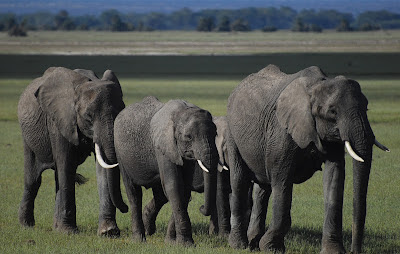
"Elephants" by Alex Strachan (Pixabay)
April gives writers a chance to play with poetry. I hope you will check out the poetry prompts created by Robert Lee Brewer, of Writer's Digest fame. He posts a poetry prompt every day (PAD) for National Poetry Month, and you can check out his poetry prompts posted every Wednesday at Writer's Digest.
Meanwhile, happy Wednesday. May your writing go well.
Will you join me in April for National Poetry Month?
Just checking in on Wednesday to give you an update of writing on the road. Truly, I can only say thank goodness for the internet!
I didn't think I'd need a map to find my way around Edinburgh for Scattered Stones. After all, we had stayed in Old Town for about a month several years back. But as the story unfolds to final draft, that bar where Murphy holds court needed a specific location. The old street name (Cockburn Street) I'd pulled off a map months ago simply didn't work. What was I thinking? I can see my readers blushing even now.
So, this morning's writing session began with that great Search feature on Google Maps as I worked the neighborhoods between the two oldest railway stations in Edinburgh (Waverley and Haymarket) where Dylan and Michael worked and lived. I felt like I fell down a rat hole! After an hour of searching (and drawing a rough map), I finally found my neighborhood bar in Old Town, just off Cowgate Street, and aptly named The Three Sisters. Sadly, we never visited, but we definitely will on our next visit to Scotland.
The Three Sisters is perfect! Nestled in a courtyard with 19th Century cobblestoned tenements on all sides, complete with tables out in the courtyard (exactly as I have described in my story) and with a stone arch, this popular bar (see picture to the right) is precisely the place where Murphy, the wardman for City Centre, would hold sway.
Only, in my story, the bar is named the Highland Inn. Hmm. Maybe I should rename my fictional bar The Three Sisters. I'd have to ask for permission. What do you think?
Stay well. Stay safe in these hopefully waning days of Omicron. See you next week!