Friday, April 13, 2018

A-Z: Inspired by "L"

Last night, I walked lost along a lakeside trail,
feeling the lack of something, a half-forgotten
lullaby linking me to this shallow pool,
almost a lagoon, dark and deep, when
a reflection of the moon
floated on the low waters.
The lovely distraction shimmered
before me, a lesson unlearned, an unfolding
legacy, as I loitered, lured closer
to a ledge, all too ready to launch myself
and leap, when the light illumined a lowly cave,
where a lady lay, lush and lazy,
her lyrics lost in sleep, her allure a promise
of something within us all,
a lovely creative light,
that urge to make something new.
With a lilt to my step, I'm loathe to leave
this lovely dreamlike lake, my lesson learned,
I've left the labyrinth of doubt, 
filled with light,
renewed, alive, and loved.

Ophelia by John Everett Millais (Wikipedia)
I don't always associate this well-known and well-loved painting of Ophelia with drowning and death (and Shakespeare), but the image remains so full of promise, a hint at the unknown, and perhaps of beginnings rather than endings. We've had a long winter this year. I'd rather write about spring.

Today's poem for April's A-Z Blogging Challenge came from playing around with words that begin with "L". 

Thursday, April 12, 2018

K is for Kill Zone

Each morning, I've begun by thinking about today's letter for the A-to-Z April Blogging Challenge. Sometimes I wind up writing about writing or travel or a poem emerges. This morning, all I could think about was K is for kill. Why?

My husband, Allen, served in Viet Nam nearly 50 years ago, during the Tet Offensive. He wrote a book loosely based on his experiences there called Reaching. It's a well-written and tragic story about a young man drafted into military service.

But last night, Allen woke me up with his shouting. He was back in Viet Nam, arguing with his lieutenant about sending one of the men in his unit into deadly fire. "How could you do that," he shouted to the young, inept, and inexperienced lieutenant just assigned to his unit. For the lieutenant would not listen to his men or his sergeant, as Allen's unit held cover near an open rice paddy. Allen's friend was shot by the enemy, picked off by a sniper, and killed.

This last week, we've been on the road, to help friends following the death of a dear friend of more than 40 years. We've slept in a different place nearly every night, my own writing has been put aside, and the headlines suggest diplomacy by tweet whether we careen closer to war in Syria or rattle missiles in the Asia Pacific.

What kind of kill zone will we create? Whose lives will be lost? Another generation of young men and women forever tainted by a politician's war?

And the rest of us, what is our responsibility?

Wednesday, April 11, 2018

"J" is for Jaguar

A few years ago, we followed our guide through the steamy and hot ancient site of Tikal in Guatemala. We climbed nearly to the top of one of the ancient ruins there, marveling at the steepness of the steps and the intricate carvings of glyphs.

Entertained by the cries of howling monkeys and shrieking parrots, we were all stunned to silence by a loud roar.

Suddenly, the rain forest around us was quiet.

Our guide reassured us. "All is well," he said. "It's unusual to hear a jaguar during the day, but he's about five miles away."

But the jungle remained quiet.

"We'll just stay here for a while," our guide said.

Very slowly, the sounds of the jungle around us resumed. We were quite happy to stand at the top of this old Mayan pyramid, peering out into the underbrush that covered the ground, and wondering if we would catch a glimpse of this amazing and feared predator.

Jaguar (Wikipedia)
For each trip we've taken, we've experienced something unexpected. This jaguar roar was unique. Unforgettable. Something to remember once we are safe at home, grateful once again for running water, doors that lock, and wildlife that stays in the forest.


Tuesday, April 10, 2018

"I" is for Indecision

Indecision is that moment
before commitment,
when all is not known and
when all is risked.
Without a word, we choose to act
or not. I'd rather take that flying leap
all by myself,
than dither between,
waiting for someone else to decide.

Even so, spring brings early pink blossoms:
we breathe change in with each passing day
and exhale, not always aware of the gifts
around us. We hesitate, perhaps we talk again,
or make travel plans on paper.
I'd almost rather hold hands than decide our future,
unfolding before us, for after all,
what remains is just this precious now.

Spring at Manito Park (Camp)

Monday, April 09, 2018

H is for Happiness . . .


Happiness is sitting in a hotel room by the patio window,
Outside a small sailboat, moored by the pier,
rests ready to go fishing up the Columbia Gorge.
On either side of the river, the hills
(Easterners would call these mountains),
are tipped with pink against a yellow sky.
Those gray streamers shift and
change in the steady wind of early morning.
The sky lightens, and traffic thrums across the bridge,
commuters early to work,
But here, laptop nearby, I watch the river, 
its surface calm,
yesterday’s whitecaps not even a memory.


NOTE: Today's entry for the A-to-Z April Blogging Challenge reflects my sense of safe haven. We found this lovely hotel along the Columbia River after driving down 4.5 hours from Spokane. We're now in a more temperate zone. The trees and shrubs along the wayside actually have green leaves! Yesterday's blustery wind made the driving challenging. I swear we landed at the hotel and collapsed immediately for a nap! This morning, the river is calm, and we'll continue on to Portland, ready to see friends. Meanwhile, for just a little while longer, I have the quiet of the river.


Saturday, April 07, 2018

G is for Galápagos

I wouldn't mind being
a tortoise, slow-moving,
land-dwelling on an island,
yet close to the warm blue sea.
My thick, hard shell would protect me
from various predators. I can just
sink into the sand, pull my head in,
duck down, no need to worry about
procrastination,
deadlines, or
writer's block.
My brain is too small.
Instead, I would live to one hundred and fifty years,
long enough to become an oracle,
my wordless spirit song connecting
the sea with the sky.

A dome-shelled Galápagos giant tortoise
Matthew Field on Wikipedia

Today's post is for April's Blogging from A to Z Challenge is inspired by the letter G. Instead of a topic related to writing, this poem came along. Why not see what others are writing about?


Friday, April 06, 2018

F is for Fearless Fiction

 
Sometimes we writers circle around a story. We're not quite willing to face down the challenge of writing this particular story, and we're not quite ready to set it aside.

Just yesterday, a writer complained she's blocked from working on her project and can't see a way to start work again. She wants to write her memoir, but it's truly too dark and would upset family members. So she's planning to fictionalize her story and change names. She's concerned that those who know her will recognize the source of her story. Plus, she will have to confront what happened to her all over again, not an easy task. Really quite enough to scare away the muse.

I had no advice for her other than to suggest that if she wants to write a family history for others in her family, write that. But if she wants to fictionalize her story truly (and she does), simply start writing scenes. Or outline the key events in a simple outline to get started and begin getting those scenes down on paper. I'll find out next month what she decides.

I also have a novel in the drawer, already written and close to final draft. It needs maybe one or two revisions before it's ready to go, but I hesitate. Like my friend, this violent story is outside my comfort zone and not at all close to the historical fiction I typically write. In these stories, most of my characters do go to dark places shaped by history: the Industrial Revolution, class wars, economic exploitation, prison, abandonment, and sometimes abuse. I love that journey to a better place, where my characters conquer all to reach a happy-for-now ending. Isn't our human experience about struggle, to reach some sort of compromise between what fate brings us and our dreams?

An internet search brings much advice on writing fearless fiction. Natalie Goldberg's oft quoted, "Write what disturbs you, what you fear, what you have not been willing to speak of," invites me to reconsider my story that's stuck in a drawer. And I'm not ready.

This morning I found an inspiring article by Carmelene Siani, "Four Simple Suggestions from a Buddhist Teacher on Living a Full Life Even When Your World Falls Apart." Ms. Siani had heard a lecture on the lessons Natalie Goldberg learned on discovering she had cancer. I found two additional articles to read and think about that may be interesting to you: Laurie Halse Anderson's “Write about the emotions you fear the most," and  Sage Cohen's "10 Ways to Harness Fear and Fuel Your Writing."

I don't have cancer as Natalie Goldberg did, though some of my friends do. The reality is that as we get 'older than average,' we do confront death (and the process of aging) in its many, not always pleasant forms. I wonder how many more books I can write, which ones, and whether that story stuck in a file drawer will ever come out.

But each morning begins with a session at the keyboard, and I write, perhaps not as fearlessly as I could. 

May April be good to you and your writing. Today's post is for April's Blogging from A to Z Challenge. Why not see what others are writing about?

Thursday, April 05, 2018

"E" is for Editing

When I daydreamed about becoming a writer, I never thought about revision or editing. Fingers poised over the keyboard, I just began to write.

After ten years of serious writing, I now realize that those planning, drafting, revising skills I taught in freshman composition apply to creative writing as well.

When I'm deep into revising and editing, I tweak my words at macro and micro levels.

Most of the time, REVISION -- that stage where I look at the chapter level and the whole book for issues like logical structure, character and story arcs, transitions, and/or plot holes -- comes before editing. Why edit sections that may be dropped or changed significantly? I'll read through that nearly final draft several times over several weeks (and sometimes months) to thoroughly analyze what needs to be changed.

EDITING for me happens at the word, sentence, and paragraph level: grammar, punctuation, and word choice (style).

I hate red pencils, but after teaching writing for 26 years, I can ink up a draft with the best. Here's where I want to slow down my focus by reading aloud. Of course, sometimes I'm distracted by issues better considered during revision, but step-by-step, I polish, analyze, and polish again.

Can I edit my own work? Yes, but let us appreciate those beta readers and professional editors who bring their skills to further polish our writing by catching revision issues and editing mistakes. I'm not a grammar witch, but I do think correct grammar and punctuation is important enough to motivate me to take just one more pass through my manuscripts before hitting that publish button.

Some self-help writing books adopt a somewhat dictatorial tone (Ah, you must . . .). I've learned to set these aside. For sheer comprehensiveness and a consistently positive tone (plus checklists at chapter ends), I recommend Elizabeth Lyon's Manuscript Makeover: Revision Techniques No Fiction Writer Can Afford to Ignore 


May your writing go well, your stories entertain and entice the reader to new understandings, and your final versions be error-free!

Today's post is for April's Blogging from A to Z Challenge. Why not see what others are writing about?

April IWSG: A Tip for Project Management

Do you ever feel a little overwhelmed by too many commitments and not enough time? Especially when working with a committee, new projects may be presented, but no one wants to take on a leadership role. Yet interest is high in pursuing the project. What filters can we use to assess and prioritize the proposed project?

Here are 4 questions my daughter scribbled on a sticky note for me after attending a recent conference.

1. How does the proposed project serve our membership?
2. Am I personally interested in this project?
3. What are the positive and negative impacts?
4. Do I (and others) have the time, skills, energy available to support this project?

In just this last week, I've adapted these questions to plan a presentation and to facilitate a goals setting meeting -- with less stress and more focus.

For example, here are those key questions adapted for a group of writers interested in audiobooks:

1. How do audiobooks help me reach my overall writing goals?
2. How interested am I in converting one of my books to an audiobook?
3. What skills do I have, need to learn, or need to hire?
4. What are the positive and negative impacts? (visibility, reaching audience, my budget)
5. How much time can I commit to this project?

This week has been incredibly busy, but the two mornings of getting up at 5am to prep for meetings and a presentation today on audiobooks for our local author's group are over. Now I can dive back into my current writing project. Yes, I took on the A-Z Blogging Challenge for April. This means I'm one day late with the post for the Insecure Writers Support Group, but I hope these questions help you analyze and manage any unwieldy projects, reduce stress, and focus on those projects that are most meaningful to you!

May April bring you warmer weather and uncluttered time to work on your goals!

Mountain Goat, Sonora Desert Museum, Tucson (2011)


Wednesday, April 04, 2018

D is for Drafting 3x5

Some writers talk about the drafting stage as that dizzying period when fingers can't quite keep up with those words that push to get on the page -- whether by hand or keyboard. Even November's National Novel Writing Month turns into a month-long writing immersion with 50,000 words as the goal.

Does drafting a story begin with an idea? an outline?

I want to say . . . depends! Some stories rest a long time in that folder, awaiting attention. I'm working on such an idea that began about ten years ago with a visit to the Museum of the Middle Ages (Cluny), in Paris to see the famous 'Lady and the Unicorn' tapestries. But now, after several fits and starts, I want to begin drafting. I have some characters. I have a working plot outline. At least this time, I know how the story ends! Or how at this point I'd like it to end. Writers know that once in full throttle, stories tend to shift and develop in unintended directions!

SIDE NOTE: Most writers fall into two categories, with each side yearning to know at times the secrets from 'the other side.' We're either 'plotters' or 'pantsers.' Plotters plan. They execute outlines beautifully and work straight through to that coveted finish. Revision is part of their methodical process. Pantsers, on the other hand, might begin with a scene and write another, not necessarily in sequence, and add another, take a break to write a character's back story, then write another scene, rearrange all madly, until 'the end' appears magically on the last page. And then revision begins. Much revision. Some call those plotters logical writers, while pantsers are intuitive.

Well, I'm truly a pantser trying to learn from those oh-so-productive plotters. After working through Randy Ingermanson's Snowflake method for the last two months, my fingers are itching to draft. Probably well before a plotter is ready to draft. I'm also setting aside time every day to study writing craft, and I'm working slowly through James Scott Bell's rather wonderful book, Just Write: Creating Unforgettable Fiction and a Rewarding Writing Life. Chapter 2 is all about how to develop your ideas and prepare to write. I'm not posting a spoiler, because this chapter is chock full of strategies. Bell's suggestion about 3x5 cards, though, intrigues me.

Usually, I use 3x5 cards on a cork board about mid-way through the story. Each card gets a scene as I doublecheck logical development, transitions, missing scenes. It's rather fun to rearrange, make sure character arcs work, pull the story apart, and put it back again.

But, Bell's idea has the writer sitting down pretty early in the process.

Imagine you are at your favorite coffee shop with your laptop and a pile of 3x5 cards. Take a sip of that dark brew we all love and simply start drafting scenes, one scene on each 3x5 card. Mind you, the draft has not been written. You may only have the sketchiest outline (if you have one at all). But you're going to draft some 30-40 scenes. 

Now comes the magic. I can't tell you for sure this is magic, but this exercise sounds like a lot of fun. Once you have those 30-40 scenes, you pick just TWO at random and look for connections, writing a new scene. I've got my 3x5 cards ready -- and maybe a little later today, I'll start jotting down those scenes. NOTE: I think this strategy just might drive the plotters nuts. 


And that's today's post for Blogging from A to Z April Challenge. Why not check out the link to see what others are writing about?

Tuesday, April 03, 2018

C: Writers and Character

When a writer looks at character,
those slippery descriptions
build a conundrum:
physical,
emotional,
and the oft talked of
(and carefully constructed)
backstory.
A piece of cake. Ha!
I offer you a view from the castle,
full of cautions.
For when the page is complete,
do our characters sing or dance?
Talk to us when the lights are out
and the computer is shut down?
And do our readers e-mail love letters,
asking for more?

Some writers pursue a long getting-to-know-you checklist that itemizes every possible 'reality' for their characters. Others hop into story, hoping their characters will morph -- through dialogue and action -- into something more than shadows of their own past.

Some writers are able to bring their characters to life with that telling detail that aches with precision and echoes in your memory as you turn the page.

Do our characters ring with truth when we create a hero who is male when we are female? Or, vice versa?

I was surprised how much my character's motivation and actions changed when I flipped genders for my hero/heroine. Shades of long ago: my female character is far too submissive; my male character too easily leaps to rescue. But I didn't 'see' what needed thinking about until I changed genders (and will, most likely change them back). 

For I'm still working on those lists and random drafts of scenes and character sketches, circling around how I create that authentic voice of my character.

Source: Nicholas Brealey


Today's post is for April's Blogging from A to Z Challenge. Why not see what others are writing about?

Monday, April 02, 2018

A to B: Ambivalent Beauty

A is for ambivalent, that tweak
of mourning yesterday, missed deadlines,
stalled story. Where is ambition?
I've lost my agenda. Again.
Before I fall into despair, today's letter
beckons. Because I can
break through this barrier:
Beauty beckons.
Connects.
Defends that inner life.
Exactly.
Finite.

Spring, Manito Park (Camp 2016)
This morning (and last night too), I was feeling discouraged about my writing. Does that happen to writers? Yes? Do we talk about it? Not often. I've been marching through Randy Ingermanson's SNOWFLAKE, having fun with a new story, but somewhat protesting along the way against the lockstep outline approach, sliding some days into nattering away.

Should the hero be male or female? Should I write a contemporary story when most of my writing has been set in mid-19th Century? Why am I drawn to the dark side of history, class conflicts, the struggle to make 'things' better? Why do I need to write at all? Aren't I at that age when it's quite permissible to simply 'play' through this next decade, perhaps my last? And how can I resolve all of these questions truly, for each day is different, yet the same?

One of my marketing goals is to send a monthly newsletter. If I were to construct a persona for reaching out to readers, this wouldn't be me. I do love spring flowers, quilt, occasionally drink tea. I'm not exactly the cheery soul my picture predicts. "But you look so nice!" I've heard that a time or two. When I think about the 19th Century, before birth control, before women's votes, before the law changed the definition of women as property, I wonder how women survived, how they created a life, fell in love, raised children, and how they achieved their dreams. And perhaps how they said 'yes,' when they wanted to say 'no.'

This current story I'm working on, The Seventh Tapestry, draws me into settings I love (Edinburgh and Paris), a web of medieval history, contemporary crime drama, and maybe impetuous love that doesn't recognize consequences. Sometimes we are driven along by our passions. Or we are not brave enough to test our boundaries. Sometimes we don't see what we risk when we welcome change. Note: This last statement seems ironic when I take such joy in living out of a suitcase with my own DH, eager to explore new locales, museums, and old towns.

On one level, the theme could be: Love triumphs! One man and one woman learn to trust each other and fall in love. Happy ending: We caught the bad guys! But what did this couple leave behind? What lies ahead? And did they truly catch the bad guys? Perhaps they feel grateful they've found that one person to build a life with. Finally. Maybe that's enough. For the true goal of genre fiction is to entertain -- with characters we can care about and hope they find, at the very least, that happy-for-now ending.

Botanical Garden, Edinburgh (Camp 2009)
Along the way, I hope my writing celebrates all those artists who with words or paint or thread somehow made and make something of beauty.

Beauty: That's today's word.
Find and nurture beauty in all its forms.
Share. Repeat with kindness and joy.

An added note: Today's post is the first for April's Blogging from A to Z Challenge. Why not see what others are writing about?

Tuesday, March 13, 2018

The Seventh Tapestry: Arthur's Seat

Even as I work on plotting and character sketches (without writing a single scene!), starting this new story, The Seventh Tapestry, is fun.

Today you'll find some possible scenes around Edinburgh that just might appear in my new story.

First, my intrepid heroine, Sandra Robertson, art appraiser/curator transplanted from San Francisco to Edinburgh, loves to hike. So wouldn't she follow that slow, steep walkway up Arthur's Seat just past Holyrood Abbey?

Arthur's Seat (Image Wikipedia)
In 2009, as part of researching Standing Stones, Allen and I spent a month in Edinburgh. How we loved the view from the stop of Arthur's Seat, looking back over Edinburgh. Arthur's Seat, a very popular site for hiking and rock climbing, was rumored to be the site of King Arthur's Camelot or perhaps that place where a dragon once landed for a nap and never woke up.

View from Arthur's Seat (Camp 2009)
Would Sandra (as we did) meander the afternoon away, sidestepping those who climb the sometimes treacherous rocks of what was once, millions of years ago, a volcano. Would she discover the ruins of St. Anthony's Chapel?

Ruins of St. Anthony's Chapel (Camp 2009)
Perhaps she would follow the trail down the back side of Arthur's Seat, to a small lake, complete with geese.

Path down from Arthur's Seat (Camp 2009)

Scottish Geese at Arthur's Seat (Camp 2009)
The Seventh Tapestry jumps ahead to the 21st Century, so these photos I took visiting Scotland nearly ten years ago, inspire me to think about the neighborhoods we visited and what Sandra Robertson might see and do where we once walked.

In the next few blog posts, you'll find other neighborhoods we explored, including Holyrood Palace/Abbey, Lawnmarket, and New Town. If you've visited Edinburgh, what was your favorite place and why?

Read more about Arthur's Seat at The Scotsman (Seven Facts . . . )

Wednesday, March 07, 2018

March IWSG: On Celebrating the Writing

After three years of research and writing, and another half a year spent in deep revision, my latest novel is complete and published. In Rivers of Stone, my intrepid heroine, disguised as a boy, treks across 19th Century Canada during the fur trading era on a quest to find her husband.

I can't say we exactly celebrated this achievement because we were too busy packing our suitcases.

On January 8, we dashed off to the Yucatan and the beautiful, quiet colonial town of Merida to escape winter snow. After seven weeks in Mexico, somehow between visiting Mayan ruins, exploring Yucatecan cuisine, and bird-watching flamingos, my next writing project emerged.

Source: Wikipedia
I'm excited because so much of this project is new. I've got a title, The Seventh Tapestry, a blurb, a draft cover, an expanded plot summary, and I'm beginning to work on character sketches. The work seems to go slowly because my normal process is more intuitive, rather like a flea jumping from scene to scene instead of working up a more formal plot summary. But inspired by Randy Ingermanson's Snowflake method, my characters are starting to breathe. They have their own quirks.

After writing three novels set in mid-19th Century, this new project is taking me in totally different directions. I wanted to work on a lighter story, something contemporary, maybe easier to write, more entertaining, and with that elusive happy-ever-after ending. Now the story is pulling together exotic locales (Edinburgh and Paris), characters who are risk takers but still willing to fall in love, and the plot plays out against the backdrop of antiquities sold illegally on the black market. At odd moments, I wonder: "Can I do justice to this story?"

This month's ISWG question asks, "How do you celebrate completing a story?" Don't we all have those moments of sheer joy, that sense of accomplishment as we hit each deadline and cross each benchmark?

As an indie writer, after the writing and revision is complete, I need to identify those action steps that lead to successful publishing and marketing the finished novel. That 'first blush' celebratory moment doesn't last very long. If I'm lucky, it transforms to an underlying sense that all is well. I move on to the next story, hopefully keeping all else in balance.

May the month be a good one for you. 

Thanks to Alex Cavanaugh and to those stalwart assistants -- Mary Aalgaard, Bish Denham, Jennifer Hawes, Diane Burton, and Gwen Gardner -- for facilitating this month's Insecure Writer's Support Group! keep writing. Or, at the least, planning that next story.

Sunday, February 11, 2018

#4: Winter in Mérida

I’m sitting in the roof garden
of the colonial house we rented here in Mérida,
a snowbird from the dry, cold lands of the north,
listening to an anonymous neighbor play
random classical piano, the notes filling the air,
as swifts and an occasional pigeon fly above me
in the cooling evening winds.  

Our rented house is built of Maya stone.
Inside, thick-cut square blocks frame doors,
exposed walls of rubble stretch to ceilings,
fans circle slowly, and
twenty feet above me, railroad ties
hold up the roof. When it’s too hot and humid,
a dipping pool awaits.  

This house rests on history, as does the city:
in 1542, Francisco de Montejo ordered the temples of T'hó torn down,
its hand-carved stones used to build Spanish palaces,
European style, superimposed on the same square,
under the same sun;
the Maya and their children, enslaved and slaughtered,
their precious books burned,
of thousands of codices, only four survive,
as did the Maya through the rise and fall of henequén plantations.

Today, this sad history plays out on the walls of the Governor’s Palace,
Castro Pacheco’s massive murals, perhaps inspired by Diego Rivera,
teach us the brutality of colonialism.
Yet, the people,
descendants of Spaniards and Maya, mixtos,
welcome temporary visitors, expats, and short-timers.
We visit what remains of the old cities of the Maya,
stand in awe under the ceibo tree and swim in cenotes.
Museums carefully display artifacts, a replica of a codex,
weather-worn stone gods, with notes in Spanish, English, and Mayan.

Some of the old mansions in the Centro are restored, some yet crumble,
their rock roots revealed. And, as the night sky descends, 
cloud jaguars race from the west along the horizon. 


House of the Artists, Merida (February 2018)

Merida Central Plaza (February 2018)

As we come to an end of our time here in Mérida, I wanted to write a poem that captures some sense of what we have experienced here -- with special thanks to the Merida Writers' Group for their suggestions.

But I left out one of the most amazing cuisines: Yucatecan food. Mayan tradition. Delicious. Mexican pastries from the local bakery (our favorite, something we dubbed 'cheeseballs', a ball of pastry wrapped around a kind of cream cheese). And another favorite for breakfast: Motuleños. Eggs over black beans, tortillas, topped with rich goat cheese and a mild tomato sauce. This dish, prepared by the fabulous cooks at Maiz, Canela, y Cilantro, is  served with sauteed plantains.


Thursday, February 08, 2018

Feb IWSG: Digging into New Projects

The short month of February begins as we, snowbirds, have just two weeks left here in Merida, Mexico, before we return to the land of snow. This week in Merida, the temperatures will average a high of 90F, we'll go to see flamingos again at Celestun, and, somehow I'll keep working on my new writing project.

In THE SEVENTH TAPESTRY, grad student Sandra Robertson wins a art internship at the Museum of Edinburgh in Scotland. Little does she know that her life will change as she discovers a mystery medieval tapestry, originally destined for the black market.

Romantic suspense (with a historical twist) is a new genre for me. Most of this month, I've explored ways to improve my plotting and character descriptions -- before I start writing.

Inspired by Randy Ingermanson's SNOWFLAKE, I started off with a 'concept blurb' that tells the entire story of the proposed novel in a few paragraphs. Then, with a deep breath, I shared this concept with a local writers' group here in Merida and a few trusted online writers with one question: Will readers be drawn to this story? Happily, the response was positive, with one writer commenting,"Readers love a quirky female lead." So, I'm poised between plotting, research, and drafting those character descriptions for the next several weeks.

Another challenge surfaced as I began describing the villain. I'm not sure I have enough research yet to define who the 'bad guy' is. I don't want to stereotype a person or a particular type, or even a country, and I don't know enough about the black market for art, other than it is roughly a $2 billion/year enterprise. Who would buy art from the black market? How far would that buyer be willing to go, if thwarted?

Back to the villain itself. Aren't there really two types of villains? There's the 'beast out of the closet' that terrifies the child in us. And there's the venial villain who makes a series of decisions, sometimes through choice, sometimes by compulsion, each step just a little push against whatever is within us that we call integrity.

Yes, I would like to improve my writing productivity. That is a fancy way of saying: Wouldn't it be nice if it didn't take 3 years to write one of my novels. But this new story is deliciously rich in history (contemporary mixed with 15th Century); settings (maybe a trip back to Scotland and Paris); and several new-to-me occupations (Scottish police, Interpol, Museum appraisers/acquisitions). I can also add the challenge of writing in a slightly different genre, romantic suspense.

That brings me back around to IWSG's question for this month: What do you love about the genre you write in most often? For me, writing historical fiction is the opportunity to explore perhaps a familiar place but through the lens of a different time. That focusing in on "what was life like then?" is endlessly fascinating. How did people survive and build a good life in spite of tumultuous change? What was life like for women in this time? How do social values change? How do we affirm our sense of integrity and a sense of direction through reading about the past? What makes some people strive and achieve their dreams, despite overwhelming challenges?

Who says writers don't have fun?

Check out the Internet Writer's Support Group for its monthly blog challenge (and other helpful resources). A special thank you to Alex Cavannaugh for founding the IWSG and to co-hosts for the February 7 posting of the IWSG are Stephen Tremp, Pat Garcia, Angela Wooldridge, Victoria Marie Lees, and Madeline Mora-Summonte.

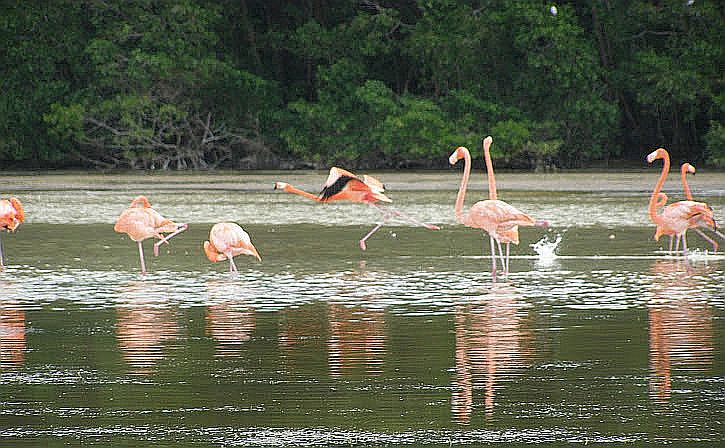
Flamingo in flight, Celestun (February 2018)

Monday, January 29, 2018

Merida #3: On Swimming in a Cenote

All I knew before we slipped on bathing suits
and stood under cold showers,
is that we were on an adventure,
you and me, traveling so far,
some forty years, to this place,
just outside Chichen Itza, Mexico,
to swim in a cenote.

From above, we peered at people below, anonymous dots,
several hundred feet down, encircled by limestone,
waterfalls, and long, tree roots searching for water.
We hiked down the stone staircase,
down and around, and down again
to float and splash in this black water alive with
history, for here, Mayans once came
in a time of drought. 
 
In some such sacred pools, cenotes sagrada,
the salt water and fresh mingle in the clearest blue,
blurring vision. The cenote connects a network
of underground caves, a doorway opens
quite properly to another world.
Researchers have found artifacts of obsidian,
turquoise, and jade, woven textiles,
and the bones of young boys.
What was lost in joy or sorrow, we still cannot decipher.
Not even the tears of the elders
could stop the Spanish from burning the codices, 
precious books. 

I cannot account for history. 
Today, it is enough to float on my back 
atop this precious water, thankful
for the waterfall tumbling down, the sky above all,
and you beside me 
for this day.

Cenote X-cajum (January 2018)
Our day trip to Chichen-Itza, where one of the sacred cenotes is located, included a side-trip to X-cajum, a nearby cenote. We were the only ones in our group to actually walk down that stone staircase to swim in the cenote. I didn't stay long, for the water was cold but curiously buoyant. 

Later I read of divers who explore the underground caves of water and who, every year, lose their way. Perhaps they can no longer see, when halocine (that mix of salt and fresh water) blurs their vision. In a similar way, time blurs our understanding of what really happened, what people believed then, and what caused them to consider these cenotes sacred, life-giving and life-taking waters.

Friday, January 19, 2018

Merida #2: At La Casa de Frida

I've long read and appreciated the paintings and writings of Frida Kahlo. Here in Merida, images of Frida appear everywhere. A young woman, who showed us through a restaurant/bar called Pancho's festooned with paintings of revolutionaries and Frida, called her 'the first lady of Mexico'.

So when we found a little cafe called La Casa de Frida on a side street, we stopped for refreshments. Later that night, this poem came:

At La Casa de Frida, Merida

I could sit in this small cafe for many hours,
surrounded by bright pink walls, my cafe con leche cooling.
Your face is painted on the table, on the backs of chairs.
Replicas of your paintings hang on every wall, and in the corner,
small, almost overlooked, a photograph of you and Diego,
both of you smiling.

Who knows of you today? You embraced the exotic,
put on vestidos of flowers, and adopted monkeys as your children.
Nearly unable to walk, you surrounded yourself with radicals,
argued with them, slept with them, and what?
Where did you find faithfulness, except in your art?

You painted yourself through pain,
over and over, a thousand bites, a few small nips,
rejection, repudiation, no mentors, no friends.
No one wanted anything from you, except
to lie beside you, to drink up your passion,
and then to abandon you, finally, to that small blue house.
Only Diego walks along that quiet street each day,
so many blocks to your garden, your respite,
your landscapes dwindle to arranged fruits.

When you die, sadness spreads everywhere,
for you were the first woman to paint
those lifelong connections so fragile,
between then and now, between politics and art,
between love and betrayal.
And so I sit, musing about the past and my future,
brushes forgotten, words not ever enough to say
your struggle to make art 
meant something to me.

At La Casa de Frida, Merida, January 2018

Wednesday, January 10, 2018

Merida #1: Settling In . . .

We've been in Merida now since late Monday night. It was a very long flight. We started our day at 4am and arrived happily in Merida about 1am. Tuesday was pretty much a lost day of catching up, warmly welcomed by Pepe and Leann of Merida Rentals and an amazing array of information. We already feel at home.

Our new house for the next two months is a curious combination of comfort and a sense of Mayan culture with sculptures, paintings, and those richly embroidered, bright pillows that delight the eye. Everywhere, this historic and restored house has surprising features. For example, the shower is set up as if I were standing beneath a waterfall. 

Our house is located on a busy side street in the central historic district. We close large, wooden shutters for privacy.  In the evening, when cool breezes move in from the sea, we sit on a rooftop patio, swinging in hammocks. In the morning, I'll take my coffee outside in a little patio, overlooking a tiny 'dipping' pool with its own fountain. 

Patio next to dipping pool and stairs to rooftop patio
La Casa Barenda, Merida
The traffic becomes a background noise, like the sound of the sea, broken by moments of traditional Mexican music from a passing taxi. Inside, fans keep us cool. It's very tranquil. No schedule. No expectations. No deadlines.

This quiet Wednesday morning, I feel free to make my own routine, to take the time to listen, to reflect, and to simply be still. In this very new place, I move more slowly through the morning, trying to decide where to write. 

Yes, it's comforting to check in with FaceBook and with family and friends now far away. Normally, all else is background until my writing is done. But this morning hints at new stories. Maybe this is a part of being retired, outside that daily commute and far from meetings (thank goodness!). But I just may find a new writing project here in this land of sun. Sometimes it's good to step away from the known.

A final thought: How the internet has changed our sense of connectedness, of community. The last time we were in Merida, some 20 years ago, we would have waited in line and then crammed into a telephone booth to talk to our daughter, her voice echoing. Now, she is a text away. As is all else. So I'm relishing this morning quiet even as I look forward to exploring this vibrant city a little later today.

If you have traveled in the Yucatan, any suggestions? Travel tips? So far, I'm in love with Google Maps as all I have to do is enter in the name of the restaurant or museum and follow the dotted lines to easily find the location. 

May all be well where you are!  


Wednesday, January 03, 2018

IWSG January 2018: Writing Goals with Coffee?

To start 2018, the Insecure Writers Study Group offers this question: What steps have you taken to put a schedule in place for your writing and publishing?

Every single time I started to plan out my writing goals for 2018, I hit a wall. It wasn't that romantic wall that I could leap over with my Superwoman cape. I was dithering, and I knew it. I didn't feel like setting out any goals at all, since I just finished a three-year project in early December. Am I really ready to start a new novel? Simply put: No!

Since I didn't want to work on any one of six possible story ideas, I did that quick 'save me' Google search to find "50 Creative Writing Prompts to Enrich Your Craft." by Bridget at NowNovel

Oh, this was fun. Guess what happened?

After writing three of these writing prompts over the last three days, I discovered I really had returned to one of my story ideas (working title, IN THE SHADOW OF A TAPESTRY). Each prompt takes me in a totally different direction. Characters, contexts, and conflicts are leaping out of the woodwork, and the story seems fresh and new. I know where I'm going now, and I'm excited about writing this story. Yes, I'll start blocking scenes, writing character studies, and building that story outline, but for now, the joy is in the writing.

What next solidified my writing goals for 2018, though, was a morning meeting last week with my small writing group at Chaps, a funky, junky, upscale cafe here in Spokane with the most delicious almond croissants and real coffee. We gathered at a round table, devoured our breakfast omelets, and talked about our writing goals. 


This is the second year we've met like this. We three -- Sue, Sandy, and me --simply sit down and talk it through. We write our goals down for writing and publishing, share them by e-mail, and then check in with each other about every 3-4 months (we meet 2x a month, but our focus then is on reading and critting). Maybe we were inspired by those almond croissants. 

Never underestimate the power of coffee and bakery goods!

Now, start 2018 off right by visiting the Insecure Writer's Support Group to see what other IWSG writers are talking about. And a special thank you to Alex Cavanaugh, our fearless leader, and his January assistants: Tyrean Martinson, Ellen @ The Cynical Sailor, Megan Morgan, Jennifer Lane, and Rachna Chhabria!