Tuesday, March 13, 2018

The Seventh Tapestry: Arthur's Seat

Even as I work on plotting and character sketches (without writing a single scene!), starting this new story, The Seventh Tapestry, is fun.

Today you'll find some possible scenes around Edinburgh that just might appear in my new story.

First, my intrepid heroine, Sandra Robertson, art appraiser/curator transplanted from San Francisco to Edinburgh, loves to hike. So wouldn't she follow that slow, steep walkway up Arthur's Seat just past Holyrood Abbey?

Arthur's Seat (Image Wikipedia)
In 2009, as part of researching Standing Stones, Allen and I spent a month in Edinburgh. How we loved the view from the stop of Arthur's Seat, looking back over Edinburgh. Arthur's Seat, a very popular site for hiking and rock climbing, was rumored to be the site of King Arthur's Camelot or perhaps that place where a dragon once landed for a nap and never woke up.

View from Arthur's Seat (Camp 2009)
Would Sandra (as we did) meander the afternoon away, sidestepping those who climb the sometimes treacherous rocks of what was once, millions of years ago, a volcano. Would she discover the ruins of St. Anthony's Chapel?

Ruins of St. Anthony's Chapel (Camp 2009)
Perhaps she would follow the trail down the back side of Arthur's Seat, to a small lake, complete with geese.

Path down from Arthur's Seat (Camp 2009)

Scottish Geese at Arthur's Seat (Camp 2009)
The Seventh Tapestry jumps ahead to the 21st Century, so these photos I took visiting Scotland nearly ten years ago, inspire me to think about the neighborhoods we visited and what Sandra Robertson might see and do where we once walked.

In the next few blog posts, you'll find other neighborhoods we explored, including Holyrood Palace/Abbey, Lawnmarket, and New Town. If you've visited Edinburgh, what was your favorite place and why?

Read more about Arthur's Seat at The Scotsman (Seven Facts . . . )

Wednesday, March 07, 2018

March IWSG: On Celebrating the Writing

After three years of research and writing, and another half a year spent in deep revision, my latest novel is complete and published. In Rivers of Stone, my intrepid heroine, disguised as a boy, treks across 19th Century Canada during the fur trading era on a quest to find her husband.

I can't say we exactly celebrated this achievement because we were too busy packing our suitcases.

On January 8, we dashed off to the Yucatan and the beautiful, quiet colonial town of Merida to escape winter snow. After seven weeks in Mexico, somehow between visiting Mayan ruins, exploring Yucatecan cuisine, and bird-watching flamingos, my next writing project emerged.

Source: Wikipedia
I'm excited because so much of this project is new. I've got a title, The Seventh Tapestry, a blurb, a draft cover, an expanded plot summary, and I'm beginning to work on character sketches. The work seems to go slowly because my normal process is more intuitive, rather like a flea jumping from scene to scene instead of working up a more formal plot summary. But inspired by Randy Ingermanson's Snowflake method, my characters are starting to breathe. They have their own quirks.

After writing three novels set in mid-19th Century, this new project is taking me in totally different directions. I wanted to work on a lighter story, something contemporary, maybe easier to write, more entertaining, and with that elusive happy-ever-after ending. Now the story is pulling together exotic locales (Edinburgh and Paris), characters who are risk takers but still willing to fall in love, and the plot plays out against the backdrop of antiquities sold illegally on the black market. At odd moments, I wonder: "Can I do justice to this story?"

This month's ISWG question asks, "How do you celebrate completing a story?" Don't we all have those moments of sheer joy, that sense of accomplishment as we hit each deadline and cross each benchmark?

As an indie writer, after the writing and revision is complete, I need to identify those action steps that lead to successful publishing and marketing the finished novel. That 'first blush' celebratory moment doesn't last very long. If I'm lucky, it transforms to an underlying sense that all is well. I move on to the next story, hopefully keeping all else in balance.

May the month be a good one for you. 

Thanks to Alex Cavanaugh and to those stalwart assistants -- Mary Aalgaard, Bish Denham, Jennifer Hawes, Diane Burton, and Gwen Gardner -- for facilitating this month's Insecure Writer's Support Group! keep writing. Or, at the least, planning that next story.

Sunday, February 11, 2018

#4: Winter in Mérida

I’m sitting in the roof garden
of the colonial house we rented here in Mérida,
a snowbird from the dry, cold lands of the north,
listening to an anonymous neighbor play
random classical piano, the notes filling the air,
as swifts and an occasional pigeon fly above me
in the cooling evening winds.  

Our rented house is built of Maya stone.
Inside, thick-cut square blocks frame doors,
exposed walls of rubble stretch to ceilings,
fans circle slowly, and
twenty feet above me, railroad ties
hold up the roof. When it’s too hot and humid,
a dipping pool awaits.  

This house rests on history, as does the city:
in 1542, Francisco de Montejo ordered the temples of T'hó torn down,
its hand-carved stones used to build Spanish palaces,
European style, superimposed on the same square,
under the same sun;
the Maya and their children, enslaved and slaughtered,
their precious books burned,
of thousands of codices, only four survive,
as did the Maya through the rise and fall of henequén plantations.

Today, this sad history plays out on the walls of the Governor’s Palace,
Castro Pacheco’s massive murals, perhaps inspired by Diego Rivera,
teach us the brutality of colonialism.
Yet, the people,
descendants of Spaniards and Maya, mixtos,
welcome temporary visitors, expats, and short-timers.
We visit what remains of the old cities of the Maya,
stand in awe under the ceibo tree and swim in cenotes.
Museums carefully display artifacts, a replica of a codex,
weather-worn stone gods, with notes in Spanish, English, and Mayan.

Some of the old mansions in the Centro are restored, some yet crumble,
their rock roots revealed. And, as the night sky descends, 
cloud jaguars race from the west along the horizon. 


House of the Artists, Merida (February 2018)

Merida Central Plaza (February 2018)

As we come to an end of our time here in Mérida, I wanted to write a poem that captures some sense of what we have experienced here -- with special thanks to the Merida Writers' Group for their suggestions.

But I left out one of the most amazing cuisines: Yucatecan food. Mayan tradition. Delicious. Mexican pastries from the local bakery (our favorite, something we dubbed 'cheeseballs', a ball of pastry wrapped around a kind of cream cheese). And another favorite for breakfast: Motuleños. Eggs over black beans, tortillas, topped with rich goat cheese and a mild tomato sauce. This dish, prepared by the fabulous cooks at Maiz, Canela, y Cilantro, is  served with sauteed plantains.


Thursday, February 08, 2018

Feb IWSG: Digging into New Projects

The short month of February begins as we, snowbirds, have just two weeks left here in Merida, Mexico, before we return to the land of snow. This week in Merida, the temperatures will average a high of 90F, we'll go to see flamingos again at Celestun, and, somehow I'll keep working on my new writing project.

In THE SEVENTH TAPESTRY, grad student Sandra Robertson wins a art internship at the Museum of Edinburgh in Scotland. Little does she know that her life will change as she discovers a mystery medieval tapestry, originally destined for the black market.

Romantic suspense (with a historical twist) is a new genre for me. Most of this month, I've explored ways to improve my plotting and character descriptions -- before I start writing.

Inspired by Randy Ingermanson's SNOWFLAKE, I started off with a 'concept blurb' that tells the entire story of the proposed novel in a few paragraphs. Then, with a deep breath, I shared this concept with a local writers' group here in Merida and a few trusted online writers with one question: Will readers be drawn to this story? Happily, the response was positive, with one writer commenting,"Readers love a quirky female lead." So, I'm poised between plotting, research, and drafting those character descriptions for the next several weeks.

Another challenge surfaced as I began describing the villain. I'm not sure I have enough research yet to define who the 'bad guy' is. I don't want to stereotype a person or a particular type, or even a country, and I don't know enough about the black market for art, other than it is roughly a $2 billion/year enterprise. Who would buy art from the black market? How far would that buyer be willing to go, if thwarted?

Back to the villain itself. Aren't there really two types of villains? There's the 'beast out of the closet' that terrifies the child in us. And there's the venial villain who makes a series of decisions, sometimes through choice, sometimes by compulsion, each step just a little push against whatever is within us that we call integrity.

Yes, I would like to improve my writing productivity. That is a fancy way of saying: Wouldn't it be nice if it didn't take 3 years to write one of my novels. But this new story is deliciously rich in history (contemporary mixed with 15th Century); settings (maybe a trip back to Scotland and Paris); and several new-to-me occupations (Scottish police, Interpol, Museum appraisers/acquisitions). I can also add the challenge of writing in a slightly different genre, romantic suspense.

That brings me back around to IWSG's question for this month: What do you love about the genre you write in most often? For me, writing historical fiction is the opportunity to explore perhaps a familiar place but through the lens of a different time. That focusing in on "what was life like then?" is endlessly fascinating. How did people survive and build a good life in spite of tumultuous change? What was life like for women in this time? How do social values change? How do we affirm our sense of integrity and a sense of direction through reading about the past? What makes some people strive and achieve their dreams, despite overwhelming challenges?

Who says writers don't have fun?

Check out the Internet Writer's Support Group for its monthly blog challenge (and other helpful resources). A special thank you to Alex Cavannaugh for founding the IWSG and to co-hosts for the February 7 posting of the IWSG are Stephen Tremp, Pat Garcia, Angela Wooldridge, Victoria Marie Lees, and Madeline Mora-Summonte.

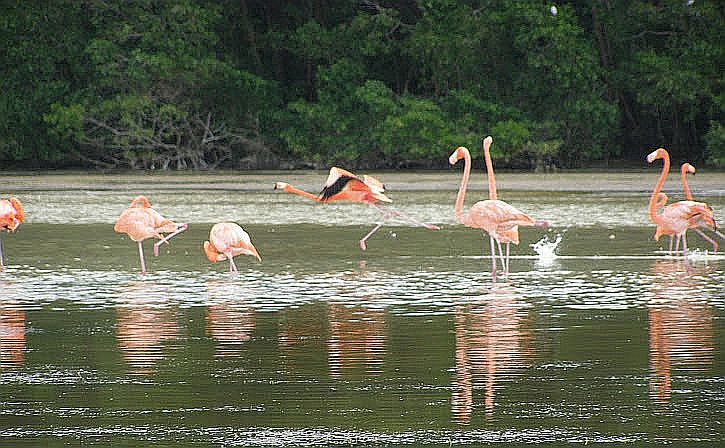
Flamingo in flight, Celestun (February 2018)

Monday, January 29, 2018

Merida #3: On Swimming in a Cenote

All I knew before we slipped on bathing suits
and stood under cold showers,
is that we were on an adventure,
you and me, traveling so far,
some forty years, to this place,
just outside Chichen Itza, Mexico,
to swim in a cenote.

From above, we peered at people below, anonymous dots,
several hundred feet down, encircled by limestone,
waterfalls, and long, tree roots searching for water.
We hiked down the stone staircase,
down and around, and down again
to float and splash in this black water alive with
history, for here, Mayans once came
in a time of drought. 
 
In some such sacred pools, cenotes sagrada,
the salt water and fresh mingle in the clearest blue,
blurring vision. The cenote connects a network
of underground caves, a doorway opens
quite properly to another world.
Researchers have found artifacts of obsidian,
turquoise, and jade, woven textiles,
and the bones of young boys.
What was lost in joy or sorrow, we still cannot decipher.
Not even the tears of the elders
could stop the Spanish from burning the codices, 
precious books. 

I cannot account for history. 
Today, it is enough to float on my back 
atop this precious water, thankful
for the waterfall tumbling down, the sky above all,
and you beside me 
for this day.

Cenote X-cajum (January 2018)
Our day trip to Chichen-Itza, where one of the sacred cenotes is located, included a side-trip to X-cajum, a nearby cenote. We were the only ones in our group to actually walk down that stone staircase to swim in the cenote. I didn't stay long, for the water was cold but curiously buoyant. 

Later I read of divers who explore the underground caves of water and who, every year, lose their way. Perhaps they can no longer see, when halocine (that mix of salt and fresh water) blurs their vision. In a similar way, time blurs our understanding of what really happened, what people believed then, and what caused them to consider these cenotes sacred, life-giving and life-taking waters.

Friday, January 19, 2018

Merida #2: At La Casa de Frida

I've long read and appreciated the paintings and writings of Frida Kahlo. Here in Merida, images of Frida appear everywhere. A young woman, who showed us through a restaurant/bar called Pancho's festooned with paintings of revolutionaries and Frida, called her 'the first lady of Mexico'.

So when we found a little cafe called La Casa de Frida on a side street, we stopped for refreshments. Later that night, this poem came:

At La Casa de Frida, Merida

I could sit in this small cafe for many hours,
surrounded by bright pink walls, my cafe con leche cooling.
Your face is painted on the table, on the backs of chairs.
Replicas of your paintings hang on every wall, and in the corner,
small, almost overlooked, a photograph of you and Diego,
both of you smiling.

Who knows of you today? You embraced the exotic,
put on vestidos of flowers, and adopted monkeys as your children.
Nearly unable to walk, you surrounded yourself with radicals,
argued with them, slept with them, and what?
Where did you find faithfulness, except in your art?

You painted yourself through pain,
over and over, a thousand bites, a few small nips,
rejection, repudiation, no mentors, no friends.
No one wanted anything from you, except
to lie beside you, to drink up your passion,
and then to abandon you, finally, to that small blue house.
Only Diego walks along that quiet street each day,
so many blocks to your garden, your respite,
your landscapes dwindle to arranged fruits.

When you die, sadness spreads everywhere,
for you were the first woman to paint
those lifelong connections so fragile,
between then and now, between politics and art,
between love and betrayal.
And so I sit, musing about the past and my future,
brushes forgotten, words not ever enough to say
your struggle to make art 
meant something to me.

At La Casa de Frida, Merida, January 2018

Wednesday, January 10, 2018

Merida #1: Settling In . . .

We've been in Merida now since late Monday night. It was a very long flight. We started our day at 4am and arrived happily in Merida about 1am. Tuesday was pretty much a lost day of catching up, warmly welcomed by Pepe and Leann of Merida Rentals and an amazing array of information. We already feel at home.

Our new house for the next two months is a curious combination of comfort and a sense of Mayan culture with sculptures, paintings, and those richly embroidered, bright pillows that delight the eye. Everywhere, this historic and restored house has surprising features. For example, the shower is set up as if I were standing beneath a waterfall. 

Our house is located on a busy side street in the central historic district. We close large, wooden shutters for privacy.  In the evening, when cool breezes move in from the sea, we sit on a rooftop patio, swinging in hammocks. In the morning, I'll take my coffee outside in a little patio, overlooking a tiny 'dipping' pool with its own fountain. 

Patio next to dipping pool and stairs to rooftop patio
La Casa Barenda, Merida
The traffic becomes a background noise, like the sound of the sea, broken by moments of traditional Mexican music from a passing taxi. Inside, fans keep us cool. It's very tranquil. No schedule. No expectations. No deadlines.

This quiet Wednesday morning, I feel free to make my own routine, to take the time to listen, to reflect, and to simply be still. In this very new place, I move more slowly through the morning, trying to decide where to write. 

Yes, it's comforting to check in with FaceBook and with family and friends now far away. Normally, all else is background until my writing is done. But this morning hints at new stories. Maybe this is a part of being retired, outside that daily commute and far from meetings (thank goodness!). But I just may find a new writing project here in this land of sun. Sometimes it's good to step away from the known.

A final thought: How the internet has changed our sense of connectedness, of community. The last time we were in Merida, some 20 years ago, we would have waited in line and then crammed into a telephone booth to talk to our daughter, her voice echoing. Now, she is a text away. As is all else. So I'm relishing this morning quiet even as I look forward to exploring this vibrant city a little later today.

If you have traveled in the Yucatan, any suggestions? Travel tips? So far, I'm in love with Google Maps as all I have to do is enter in the name of the restaurant or museum and follow the dotted lines to easily find the location. 

May all be well where you are!  


Wednesday, January 03, 2018

IWSG January 2018: Writing Goals with Coffee?

To start 2018, the Insecure Writers Study Group offers this question: What steps have you taken to put a schedule in place for your writing and publishing?

Every single time I started to plan out my writing goals for 2018, I hit a wall. It wasn't that romantic wall that I could leap over with my Superwoman cape. I was dithering, and I knew it. I didn't feel like setting out any goals at all, since I just finished a three-year project in early December. Am I really ready to start a new novel? Simply put: No!

Since I didn't want to work on any one of six possible story ideas, I did that quick 'save me' Google search to find "50 Creative Writing Prompts to Enrich Your Craft." by Bridget at NowNovel

Oh, this was fun. Guess what happened?

After writing three of these writing prompts over the last three days, I discovered I really had returned to one of my story ideas (working title, IN THE SHADOW OF A TAPESTRY). Each prompt takes me in a totally different direction. Characters, contexts, and conflicts are leaping out of the woodwork, and the story seems fresh and new. I know where I'm going now, and I'm excited about writing this story. Yes, I'll start blocking scenes, writing character studies, and building that story outline, but for now, the joy is in the writing.

What next solidified my writing goals for 2018, though, was a morning meeting last week with my small writing group at Chaps, a funky, junky, upscale cafe here in Spokane with the most delicious almond croissants and real coffee. We gathered at a round table, devoured our breakfast omelets, and talked about our writing goals. 


This is the second year we've met like this. We three -- Sue, Sandy, and me --simply sit down and talk it through. We write our goals down for writing and publishing, share them by e-mail, and then check in with each other about every 3-4 months (we meet 2x a month, but our focus then is on reading and critting). Maybe we were inspired by those almond croissants. 

Never underestimate the power of coffee and bakery goods!

Now, start 2018 off right by visiting the Insecure Writer's Support Group to see what other IWSG writers are talking about. And a special thank you to Alex Cavanaugh, our fearless leader, and his January assistants: Tyrean Martinson, Ellen @ The Cynical Sailor, Megan Morgan, Jennifer Lane, and Rachna Chhabria!

Wednesday, December 06, 2017

Dec IWSG: Celebrating 2017

December 6. Today's my birthday. I celebrated by pressing that 'publish' button on CreateSpace to finally go live with Rivers of Stone, historical fiction set in 1840's Canada.

Better than a birthday cake.

Now that I'm older than dirt, I'm celebrating 10 years of retirement with this third book, the next installment (roughly speaking) in a family saga that began with the McDonnell family's struggles during the Clearances in Scotland (Standing Stones). The second book, Years of Stone, follows Mac McDonnell (and his sweetheart), as he's transported to a penal colony in Australia. Rivers of Stone tells the story of Catriona who marries Dougal McDonnell -- and winds up in Canada. Each book has taken me roughly 3 years to write, revise, and then publish.

So I'm doing the happy dance today . . . and not just about the writing. My friends and readers are celebrating with me.

THANK YOU to everyone who says an encouraging word to a writer, who shares expertise, and who gives critical (and useful) feedback on rough drafts. Regardless of the hour, whether we're wearing bunny slippers or  not, we all benefit.

And we all learn from each other. So here's the latest gift (perhaps unintended) from author Octavia Randolph who recently posted this gorgeous ad on Facebook for her remarkable story, The Circle of Ceridwen.


I kept staring at the design, the sharp contrast between black and white, the way the eye is drawn to the cover. Hmm. Could I do this? So, I did, futzing my way through PowerPoint, photos taken in Canada, and the cover from Rivers of Stone. For we learn from each other.


What do we most care about as writers, once we're past writing the best story we can? I think it's about connecting with other writers, learning from each other, and sharing our stories. We all doubt. The list is endless. Sometimes we're blocked. But we know that passes. Most of the time. We have stories to tell, words to get down on the page, and those moments to share, to celebrate.

If I were to do anything differently about my writing this last year or in the coming year, it is to cherish these connections with other writers and my readers. Let us persevere, enjoy each day of the coming (mild?) winter, and write, well aware of the ripples we create.

Why not hop right over to the Insecure Writer's Support Group to see what other IWSG writers are talking about. And a special thank you to Alex Cavanaugh, our fearless leader, and his minions, Julie Flanders, Shannon Lawrence, Fundy Blue, and Heather Gardner!

Tuesday, November 14, 2017

Part 2: Exercise Yourself! Digging into Deep Revision

In my last post, I talked about how I came to teach a workshop on deep revision, defined some common editing terms, and introduced a working definition of deep revision.

Today's post presents an exercise that brings you closer to understanding how 'unconscious' writing may help your own writing -- even deep revision.

FREE WRITE: IT'S ALL ABOUT YOU! Thinking on paper about what you write, how you write, and why, can help you see new patterns in your writing practice. The goal here is to move us to think outside of an outline, perhaps in a nonlinear way.

So, take a piece of blank paper and fold it into 4. Starting with the first square (doesn't matter which one), label it and then jot down your answers to the questions that follow. When you finish with one category, move on to the next square.

1. WHAT: In this square, jot down your answers to these questions: What are you working on now? Note whether you tend to write plot-driven or character-driven stories. What stage is your current project? Idea + content map? Outline? Drafting? First/second/third draft? Revising? First/second/third round of revision? Beta read? Edit stage? Copyedit? Proofreading?

2. HOW: In the next square, jot down a few comments about how you write. Where do you best write? What time do you write? For how long? How many times a day? a week? And how do you write? pen/paper? Computer? Dictation?

3. WHY: In the next square, draft a statement about why you write. Now answer, 'What pushes you to write THIS story? That is your current work. And, can you identify a theme in your current story? Does this theme reappear in any of your other writing?

4. WHAT IF? (Set this aside until AFTER you've reviewed the following:

DEEP REVISION may require you to let go of the 'normal' way you analyze your writing. Our GOAL here is to identify how different levels in your writing connect with each other and reflect each other. All writers, whether we acknowledge it or not, tend to write on several levels. The deeper we go, the less we may 'know' exactly what we're doing. So, how do we encourage that 'unconscious' part of our mind when we write?

And why should we?

In PRE-WRITING, writing faster than we think possible can lead us to get unexpectedly new ideas down on paper. Some writing challenges -- like National Novel Writing Month (NaNoWriMo) which asks us to write 1,667 new words a day, every day for the month of November -- can spur some writers to amazing productivity -- and break through writer's block.

At the DRAFTING stage, consider how some writers sprint. These writers write as fast as they can, without an outline, without revision, with little more than a germ of a concept or storyline. Some writers write from outlines, and some are so reflective, they meditate for a time before getting each sentence down on paper.

If we compare DRAFTING with REVISION, drafting fast can draw from your unconscious mind, while revision, a more analytical process, involves more of your conscious mind. Please note, I'm not talking about the right-brain/left-brain dichotomy here. I believe we all have fully functional (most of the time) right (rational) and left (intuitive) brains at work, depending on the situation and what we ask of ourselves.

What activities could help me tap into my 'unconscious' mind for writing?

  • Slow, calm, repetitive activities like walking, driving, showering, or even folding laundry can lead to unexpected insights or ideas that feed right back into your writing.
  • Meditating with a goal for short periods can leave you refreshed and with new ideas. Start such a session with a few moments of reflection. Ask "What do I want to achieve?" and then simply let go with slow breathing for about 10 minutes.
  • Thought-dumping allows you to write fast without editing. Be inspired by Julia Cameron's Morning Pages (write 3 pages each morning without stopping), or Natalie Goldberg's timed writing exercises at any time of the day. Key to both: Simply write without going back and without making any changes.
  • Right before going to sleep, ask yourself a question about your story or think about a specific aspect of the story you've been working on. Or, as Thomas Edison put it, "Never go to sleep without a request to your subconscious." Since I typically write first thing in the morning, practically leaping out of bed to take advantage of that quiet hour, I've happily used this particular tip many times, without realizing others also try this.

After the workshop, one writer came up to me to say, "Here's a tip to tap your unconscious that I bet you've never heard of. Read tarot cards for your character or ask a story-related question." I celebrated the moment with her, for I've done this one too, with quite interesting results, again without realizing other writers would find this a useful or interesting exercise. 

Now, pick up that piece of paper that's been divided into four squares. Go to #4 WHAT IF? Which of the above suggested activities, from morning pages to thinking-while-sleeping to reading Tarot cards would you be willing to try? Write them down in #4.

Please come back in a few more days to read about one more activity to help you map out your own 'deep revision' with Part 3: Mind Mapping.

Or go back to Part 1: Working out with Deep Revision to see how we got started on this topic.

Let me know in the comments or by e-mail what YOU think and if you've tried any of these tips. Meanwhile, may your writing go well -- on all levels!

Fall afternoon at Manito Park (October 2017)

Saturday, November 11, 2017

Part 1: Working out with deep revision . . .

I miss teaching. Earlier this week, I got to teach a workshop on deep revision, and had so much fun prepping, researching, planning activities, and then running the workshop itself with 20 eager writers.  So here's a bit of what I learned with a little backstory.

The back story: I've spilled the beans here in my blog that for my current wip, Rivers of Stone, I had hit a revision wall with the story not jelling at that crucial ending and some very useful but challenging feedback from beta readers. I wanted to be finished, but the story was not done with me.

What my story needed was a major restructuring of one main character and a rethinking of how she interacted with the other characters (and how they interacted with her). That was nearly enough for me to want to put the whole story into a file and forget it. After a few months of waffling and struggling with the 'how' to move forward, my DH came to the rescue.

You should hear us talk. Allen thinks in logical structures and works through ideas the same way. When he writes, he spends a lot of time just thinking and then very slowly writes his story one sentence at a time. I tend to think, debate, and write intuitively, leaping in a nonlinear fashion through my projects.

Allen explained that with literary fiction, the writer works on different levels, sometimes consciously and sometimes unconsciously. As we work deeper into any story, those levels become more difficult to change.

What does Snow White have to do with deep revision?  So let's use Snow White to think about four levels of fiction commonly found in literary fiction.

STORY involves the surface elements of plot and character that are relatively easy to change. In Snow White, a beautiful and innocent daughter is feared and hated by her father's new wife. Dispatched to the forest to be killed, she wanders alone, is taken in by a band of dwarfs only to fall into a coma after eating a poisoned apple. Snow White is saved for her happy-ever-after by the kiss of a handsome prince.

STYLE is that unique voice (or persona) of the storyteller that infuses the story, its point of view, word choice, and mood. Imagine how many times you've heard the story of Snow White and in how many different 'voices.'

THEME is a universal idea that affects everything in the story. It may be expressed in a few words, and the theme shapes the story and is difficult to change. In Snow White, the theme might be 'true love rescues innocence.'

SYMBOLISM are those compelling images/objects that appear in the story. For some, that compelling image might be the poisoned apple or the handsome prince's kiss.

To begin deep revision, we need to look at these four categories in our stories.

What in the heck is deep revision? The Freelance Editorial Association identifies FOUR categories of revision: Developmental (working at the concept, outline or draft to develop the story); Substantive (improving the overall manuscript by restructuring, reorganizing, and rewriting); Copy editing (reviewing style, format, and grammar -- among other elements -- for consistency); and final Proofreading.

I also found this fascinating checklist by Waverly Fitzgerald on deep revision that listed the kinds of questions a writer could ask.

But, none of these categories of revision seemed to fit what I experienced in revising my draft.

For me, deep revision involves the rethinking of a story and its basic elements -- character, plot, point of view, setting, style, theme, and symbolism. This kind of revision can happen at any point in the writing process (planning, drafting, or revision), and, if you're truly unlucky, during final revision.

So, what does deep revision mean to you? If you write more methodically, these questions about revision may not trouble you. Or, have they? If you write intuitively, what has been your experience with revision?

Tune in later this week for Part 2 -- You'll find exercises we used in the writing workshop to analyze what kinds of revision we might need, how the elements of our story fit together, and how we might tap our unconscious for drafting and revision.

As you pursue your own writing, take a few moments to enjoy the transition from fall to winter:

Manito Park, October 2017

Wednesday, November 01, 2017

IWSG: Roads Taken . . . And Not Taken

Robert Frost, in his famous poem, "The Road Not Taken," wrote:

Two roads diverged in a yellow wood,
And sorry I could not travel both . . .

That's November for me, for I faced two major challenges and could not decide which road to take, while remaining not quite ready to give up either path.

Goal #1: To finish those final edits and formatting so that Rivers of Stone, Book 3 of my McDonnell Clan series could be published before December.

Goal #2: To get a running start on a new story with NaNoWriMo, starting actually today. I've done a bit of work researching, mapping, drafting character sketches, and am (as a diehard pantser), ready to write -- maybe even write those 50K words in one month.

I began to feel inadequate. Not productive. Caught in that negative downward spiral when the muse sulks and won't soar. A long walk later, and coffee with my dearest daughter, I stopped focusing on who I would disappoint, including myself, if I didn't reach either goal. 

Instead, I asked: What is it that I really want to achieve?

The answer came almost immediately. Finish those edits/formatting first. Commit to just 250 words a day on NaNo until I can write more. I'm ready now to work on both, filled with a sense of optimism and joy. So much for the 'road not taken,' at least for November.

This month, the Insecure Writer's Support Group (IWSG) asks us to share whether we've ever finished writing projects we started in NaNoWriMo, and, if so, have any of our NaNo projects gotten published. For me, the answer is yes to both, for that month of pushing for 1,667 words a day, every day, has given me delicious drafts. And as an older-than-average indie writer, I publish when that revise-revise-revise process is complete.

May November be filled with joy and thankfulness -- and many words. As the month unfolds for you, why not check out what others have written as they check in for the IWSG HERE.

November Afternoon at Manito Park, 2017


Friday, October 27, 2017

October 27: A Long Journey Ends


A long journey ends:
African violets bloom
a purple welcome.

Outside fall leaves shift
red and gold to barren trees.
And now, winter comes.

But I remember
the way the sea and the sky
hold the world as one. 


Today’s poetry prompt from Tamara Woods, OctPoWriMo, suggests remembering flowers and then writing a poem following that classic form of a Haiku – that is a poem with 3 lines, with the first line having 3 syllables, the second line, 7 syllables; and the last line again having 5 syllables.

When I think of flowers, I most remember the African violets that grow in my office. They give me comfort and help me balance a sense of beauty with a constant use of technology. This last trip, 14 days down the coast of Mexico, reintroduced me to the limitless sea. Now home, I'm still adjusting to that time change!

Why not read what others have written at OctPoWriMo in this month-long poetry challenge.


Thursday, October 26, 2017

October 26: Coming Home

After weeks away, I come home,
opening doors and seeing anew
unfinished projects, beloved books, beloved you.

We’ve traveled far, you and I,
suitcases emptied once again,
after weeks away, I come home

To water the plants and gather the mail.
I stand for a moment beside the patio,
opening doors and seeing anew

The leaves outside so quickly changed to red.
I pick up the threads and find the words for
unfinished projects, beloved books, beloved you.

Manito Park (Fall 2017)
Today’s prompt for OctPoWriMo comes from Morgan Dragonwillow. The form of this poem, Cascade, is new to me. The underlying theme is ‘receptiveness.’ As we’ve just returned from two weeks away, these images seemed very dear. 

Learn more about this poetry form HERE http://shadowpoetry.com/resources/wip/cascade.html or stop by to read what others have written HERE http://www.octpowrimo.com/p/octpowrimo-link-up.html

Wednesday, October 25, 2017

October 25: Desayuno

A guilty pleasure:
Hot, dark coffee, half milk,
little croissants, 
fresh fruits cut small, pineapple, 
mango, banana, melon.
No daily newspaper to distract me.
No internet.
Nothing but the wide blue sea,
calm from horizon to horizon
as I sit quiet in the early morning, isolated.
After a week of cruising down the west coast of Mexico,
the ship turns north into the Caribbean;
we’ll skirt Cuba, come home to New Orleans.
This temporary bubble will pop.

Breakfast on the Norwegian Pearl

What I went through to get that breakfast!
My morning table on a good day (before the crowds)
Today's prompt from Amy McGrath for OctPoWriMo asks us to write about the taste of satisfaction. My first (and mixed) reaction was recalling last week's lovely early morning breakfasts on board the ship. 

Why haven't I made such special breakfasts at home? Maybe because I worked beyond full time. Breakfast was always hurriedly assembled and eaten. Would it be so difficult in these low-fat days, perhaps once a week to plan a breakfast with those lovely, not quite as good as 'real' croissants, but still, coffee, croissants, and fruit?

Yes, we're home, struggling a bit with time change (I'm still getting up at 3 am), but underneath this poem is that sense of how living on a cruise ship, even for 14 days, is isolating. Perhaps that's the point of going, but a part of me is uncomfortable being surrounded by people eager to be entertained  and served, with no respite. I did enjoy the sea, as did my DH. The ship did have a library, and the staff was made up of young people from all over the world. But it's good to be home, catching up with those I love -- and those projects!

Let's go see what other OctPoWriMo poets have written this morning!

Thursday, October 05, 2017

October 5: Letting Go

Perhaps I do understand what I didn’t know yesterday
as the suitcase fills up, the airline tickets
print, the alarm set for 4:00 am.
Everything that I know and love
will remain here for now;
for the next weeks,
we sleep aboard
a ship,
elsewhere.

Today’s OctPoWriMo prompt is to brainstorm a list of the things you now understand that maybe you didn’t quite comprehend before. Distracted by preparations for our coming trip that leaves this Saturday at 4 am, I couldn’t see a way to respond to the prompt . . . until I found Robert Lee Brewer’s list of poetic forms online on The Writer’s Digest website

The Nonet, a nine line poem that starts with a 9-word line, with each following line one word less, intrigued me because Brewer says this poetic form is a sort of ‘count down’ poem. We are certainly counting the hours down just now before this trip begins.

Tomorrow’s poem will be my last posted poem until August 26th, for we will be traveling down the coast of Mexico without any access to internet. 

Meanwhile, here's the link to OctPoWriMo poets. May you find poetry every day and everywhere!

Pigeons of San Miguel de Allende (Camp)

Wednesday, October 04, 2017

October IWSG: Have I Slipped?

I typically spend about three years in writing my historical fiction stories, all set mid-19th Century in times of great upheaval. My characters struggle, and I love to write about them as they fight their way out of despair to a new life they’ve crafted.

In Standing Stones, Mac McDonnell protests evictions by the new landowner of a tiny island in northern Scotland. As Book 1 ends, Mac is jailed, sent to a prison ship in London, and then shipped to a penal colony in Australia. 

Years of Stone, Book 2, follows Mac as he struggles to survive a seven-year sentence in Van Diemen’s Land. Mac doesn’t know that Deidre, his sweetheart, has followed him. Do they get that ‘happy-ever-after’ ending?

That leads me to Rivers of Stone, Book 3 of the McDonnell clan. 

I loved researching and planning the story of what second brother Dougal McDonnell did as he left his island home. But Rivers of Stone is really about Catriona’s journey. She disguises herself as a boy and, with Dougal, is hired by the Hudson’s Bay Company (based on a true story). Once they land at York Factory in Upper Manitoba, Cat and Dougal are separated. 

Catriona’s inventiveness, and chance meeting with Canadian artist Paul Kane, take her all the way to Fort Vancouver in the Oregon Territory, a wonderful story that essentially asks: Will Cat and Dougal get that ‘happily-ever-after’ ending.

In the earliest drafts of Rivers of Stone, I struggled for months over how to stage that ‘happily-ever-after’ ending, for essentially Dougal abandoned Catriona at the first opportunity. How could she forgive him? After the first draft was complete, I realized (with the help of beta readers) that I had profiled an abused wife. This was not the story I wanted to tell.

I do write intuitively and then work as logically as I can. With Rivers of Stone, for some reason, my characters played out the drama of my childhood. I didn’t realize how toxic and how long lasting these underlying issues were. Despite many years of a solid marriage, I still painted the picture of a woman who was mistreated, undervalued, and abandoned. 

Deep revision followed, and I am happy to report that Catriona displays the strength and personal growth of a true heroine.

This month’s IWSG question is: Have you ever slipped any of your personal information into your characters, either by accident or on purpose? 

My answer is yes, but, thank goodness for editing and perseverance! Working on the emotional bedrock of a story, its subliminal message, is not easy. But maybe that’s just what readers take away after they finish reading that last page.

Thank you to IWSG October co-hosts Olga Godim, Chemist Ken, Jennifer Hawes, and Tamara Narayan! Read what others have posted for the Insecure Writers' Study Group HERE.

Have a great month reading and writing. Remember that NaNoWriMo is just a few weeks away.

October 4: Where Does Poetry Hide?

I’d like to think that poetry
hides under my bed,
inspiring dreams. Early in the morning,
just before I wake, words dance 
along my eyelids, 
bringing me to that half-life
of awareness.

I can’t quite remember anything
after I’m awake,
other than the shape of the words
laid out on a page,
staggering toward some meaning,
rather like a paint by number,
the colors not filled in,
and my brush strays outside the line.

Street Art in Sao Paulo, Brazil (Camp 2009)


Today’s OctPoWriMo prompt invites us to explore where poetry hides in our life. Thank you, Amy McGrath, for your lovely photos and invitation to write. 

Most of the year, I do wake with words and images for the morning writing session, but, for me, poetry hides throughout the year, except for October and maybe April. The rest of the year, I'm writing and editing stories!

Click HERE to read what others have written -- and enjoy!

Tuesday, October 03, 2017

October 3: Untitled Cherita


after packing my suitcase one more time

Tucking your postcard
into my daybook

A packet of letters on thin paper
comes unbundled,
little cherished histories


Cherita is the Malay word for story. This stylized poem is presented without a title. Its three stanzas are centered and have one 1 line, 2 lines, and end with 3 lines. I hope my little poem gives the sense of a story in this tradition. 

Today’s OctPoWriMo challenge was to write a cherita, perhaps around the theme of metal. Click HERE to read what others have written -- and enjoy!

The photo is by Liz West on Flickr of a packet of letters she bought at an auction. They were written in the 1860's.

Monday, October 02, 2017

October 2: Maybe the First Time

Maybe the first time,
some rhythm of song
resonated to your bones,
and you noticed you were different.
Or was it the shock
of a blow
that led to stars,
white stars that circled as spirals
into words only you could hear.
You became an observer,
watching, not dispassionate,
but once removed,
recording for some unseen audience
you knew would listen
to these words
that finally spilled out on the page,
well before laptops or i-pads or texts,
words that the heart knows. Sometimes
we write because we must.


I'm posting a little late with today's poem (and picture taken earlier this summer in Manito Park), for it's after 11 pm here on the west coast. A busy day, but OctPoWriMo's prompt for today was to free write for ten minutes stating, "We write because we must."  Click HERE to read what others have written -- and enjoy!

Sunday, October 01, 2017

Oct 1: How Did I Get to This Place?

Manito Park, Spokane (Early Fall 2017)

How did I get to this place?
Every day edges closer to the end of my days,
from west coast to east, across oceans,
north and south, other languages tumble
in the wind of this journey. I remain
always grateful for each year with you.
Seasons wind round again and again,
while I, fueled by the blood of Vikings,
fight down night terrors to make
our home, a respite.

Today’s prompt from OctPoWriMo included these jumping-off words: family tree, DNA, roots and branches, origin story, ancestry, heritage, and the question: “How did I get here?” Click HERE to read what others have written. 

This year, we'll be traveling once again -- far from internet! So while I can only post these poems written for OctPoWriMo through Friday, October 6, I'm taking a journal with me and will post on our return -- after October 25.

I took this picture of the Japanese Garden in Manito Park in early fall. Why do I love participating in OctPoWriMo? Because it's a nice break from writing historical fiction. Because I enjoy that nonlinear connection with images and ideas that seem very different every day. I hope you join the challenge!

Thursday, September 28, 2017

September 28: The Role of Poetry?


When words emerge
in a certain shape on the page
or rhythm within, close to the sounds
of each vowel of my heart,
I think poetry is a little anchor
to this moment, something small,
so personal that
what remains on the page
is hard to share with others
and nearly impossible to read aloud.

But these words help me recognize
my own white hair in the beginning of winter
in that line of snow birds heading north,
and to see again the ending of summer,
as we walk along this tree-lined path,
leaves above us curling red and yellow to brown.

I do not count words in a poem
or rage as much as I should
against all those worldly wrongs.
Some stories, some poems resonate
larger than life, then slip away,
one line at a time. Like a crane,
Its steady walk profound,
I move without regret . . .
as yet, unfinished.

Today’s poem tries to answer Tamara Woods’ question, “What is the role of poetry?”, in her post for OctPoWriMo HERE. The picture of that beautiful white crane comes from Jeffrey Stemshorn, a Tucson photographer with the vision of a poet who is dear to my sister.

Wednesday, September 27, 2017

September 27: Follow the Flower that Bends


Even in early spring,
one flower always seems
to bend in its own direction,
as if to say, “Follow me. I know
where I am going.” 

Over the years, I have followed you
here and there, everywhere,
at home in a world of other-ness,
affirming we are one community, at peace.
And then nature blows the flowers away,
the houses, the wires that connect us so well,
bringing death and destruction.
“We know death is
inevitable,” one forlorn wife says,
“But that does not mean
we are ready.”

I am wishing for
that one flower that points the way,
bending slightly to a path
that few follow.
In the spring, we will shake loose routine.
A lot older now, we cannot quite travel
as we once did. But our hearts
are together,
here and there,
everywhere.

Today's poem came early this morning as we prepare for a trip that means we'll be far from internet from October 7 through October 25. Despite my commitment to OctPoWriMo, I won't be able to post that daily poem. But I will write in my journal and post on our return, hopefully with pictures and new adventures to share.

Saturday, September 23, 2017

September 23: Lost in Translation

She stood center stage
and began to sing in Spanish,
that song she wrote over the summer.

I caught a word here and there,
mi amor perdida, a tale
of love lost unfolding,
and I recognized in that lilting beat
set by her hands in tandem,
guitar and voice,
a stylized dance, answer and response,
her voice quavering with passion. 

The audience remained largely unaware
of nuance or pain,
or how much we lost by not knowing the words,
those words that spun away.
She had no CD, and I had no way to remember
this moment of performance,
the young guitarist who sang from the heart,
of her lost love and all
that lay before her.

Today's poem honors the singing and songwriting Brigid Walsh who sang at September’s POETRY RISING gathering here in Spokane, hosted by Stephen Pitters. The next POETRY RISING is set for November 15th, 6:30 pm, Barnes & Noble, Northtown.

Friday, September 22, 2017

September 22: Between

Something of beauty:
Isn’t that what we aspire
to make concrete
the indefinable?
Somehow between and
out of the bits and scraps of our lives,
whether hours in an office or at home,
we do create harmony out of chaos.
Yes, sometimes ‘tidy’ will win.
But, who paints
with abandon at 3am?
Who makes the moment come alive
by tracing a line of pine trees
against a star-filled sky?
Or dreams with the tenacity of a writer,
who word-by-word
builds a poem?

Fall at Finch Arboretum

Today's poem came along because I had no time. Meetings ahead. A long list of to-do, longer than I can do today. So I thought of all the times when we work to make space for others and ourselves, those moments that do nurture us.  And somehow this picture I took at Finch Arboretum talks to me of the change of seasons and what we do 'between.'

Please consider joining the month-long poetry challenge that begins October 1 by writing a poem a day. Find out more HERE for OctPoWriMo

Wednesday, September 20, 2017

Sept 20: On Rocks and Spines

Who can see the turn of seasons
in the blossoms that turn to brown
here in the desert?
We pick our way past cactus
in every form.
Even guardian Saguaro promise
months of heat ahead
while palm fronds wither.
The rocks remain,
sedimentary in layers,
sturdy, persevering.
We return each year,
snow birds who warm our bones
in this land of rocks and spines. 

"Secret Garden" by Jeffrey Stemshorn

Tuesday, September 19, 2017

Today's Poem: "Cosmos"

Cosmos

Sometimes we forget
the stars spin above us.
As we wheel through the sky,
an unending cycle of stars circles us.
We turn again and again,
day to night and night to day.
We burrow into each precious day,
encumbered by schedules and routine.
We take this round of days for granted
until we count the hours to that moment
when time stands still
and we see the stars anew.


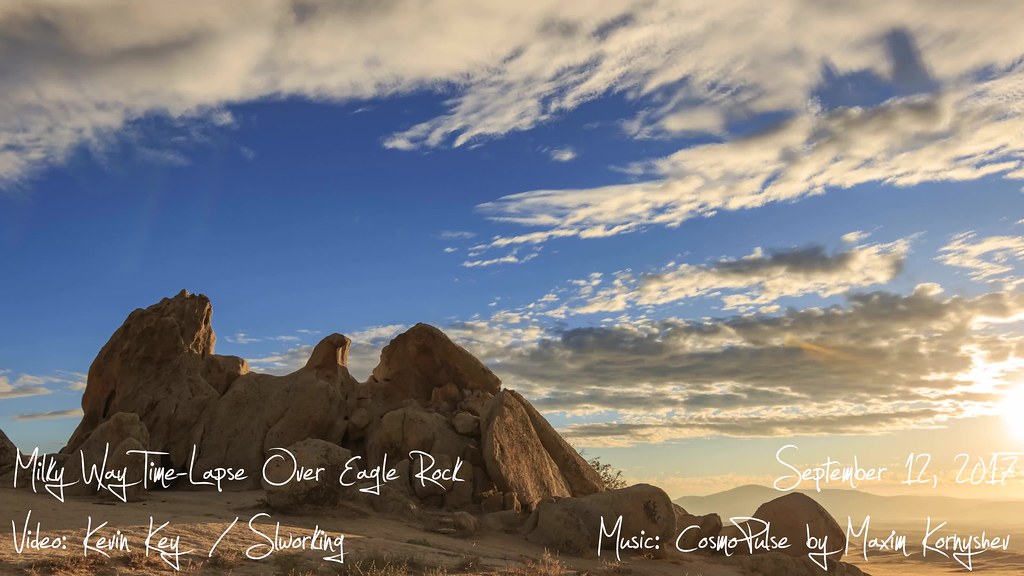
Eagle Rock Sunset & Milky Way Time-Lapse

Yesterday's poem "Rockpile" is still at draft stage, but the images in this one-minute video led me to write "Cosmos" as I explored Flickr and found Kevin's video of "Eagle Rock Sunset & Milky Way Time-Lapse."  See more of Kevin's work HERE, including some stunning shots of the eclipse. 

Expect to read more about rocks . . . a little later.

Sunday, September 17, 2017

POETRY on the road . . .

That poetry writing challenge, OctPoWriMo, starts October 1. Am I ready to write a poem a day for the entire month of October? 

Don't know, but here's a warm-up poem inspired by Daily Write:

On the Road

Slam shut that lock on the suitcase:
We’re ready for another trip.
Where?
I don’t care.
Just shake the dust
off those tired beds
that slant to one side,
those early mornings
that roil with routine.
Am I too old to travel without a destination?
Don’t think so.
We’re all headed to our own unique ending,
with or without grace,
as fast as we can go.


from Daily Write


Sign up to participate in OctPoWriMo by October 2  
(or learn more about this poetry challenge)  CLICK HERE